Reducing Customer Service Costs with Smart Automation
Discover how to cut support costs by up to 40% while improving customer satisfaction through intelligent automation.
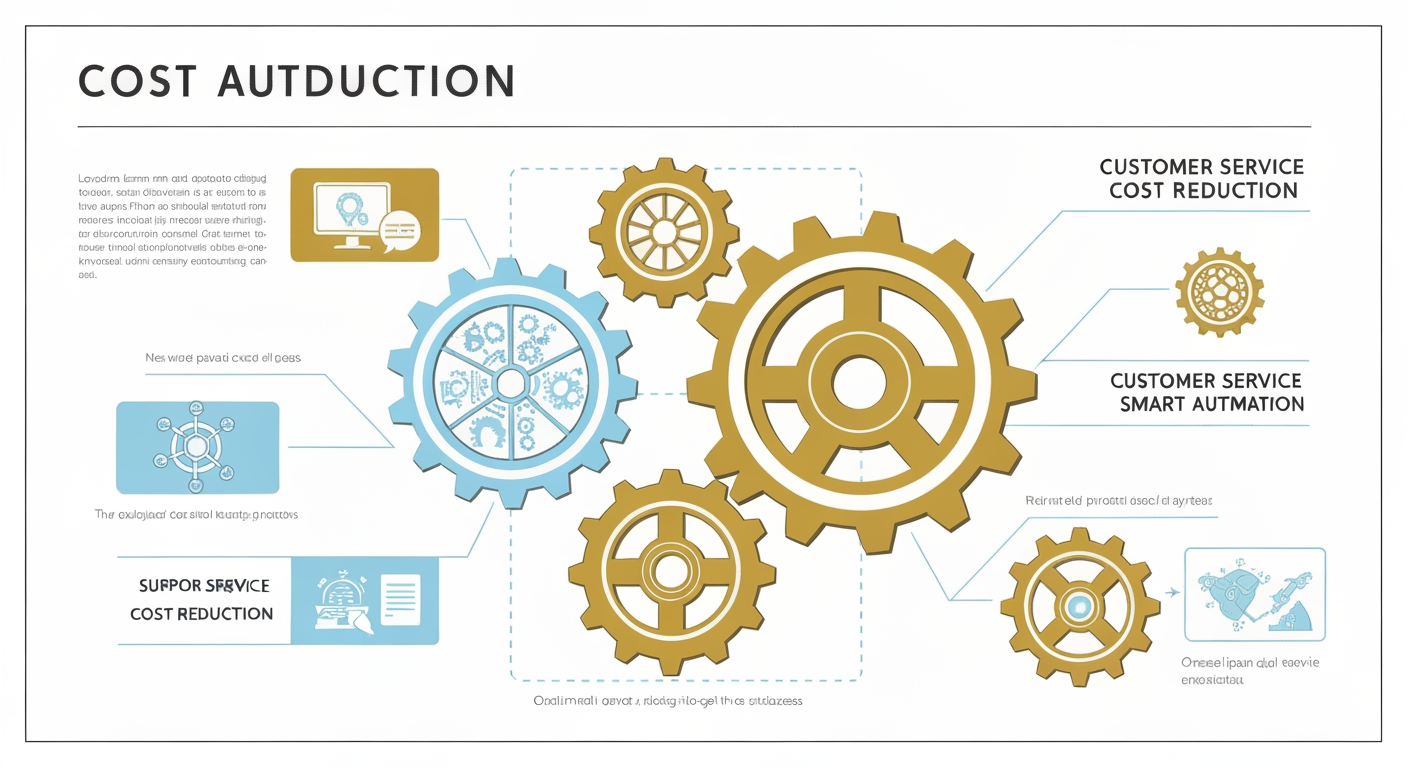
Customer service is often viewed as a necessary cost center, but smart automation can transform it into a strategic advantage—delivering better experiences at significantly lower costs. Here's your roadmap to achieving 40% cost reduction without sacrificing quality.
Understanding the Cost Structure
Before optimizing costs, understand where money goes. Typical customer service costs include: agent salaries (60-70% of budget), training and development (10-15%), technology and tools (10-12%), facilities and overhead (8-10%), and management and quality assurance (5-8%).
Smart automation targets the largest cost driver—agent time—by handling routine queries that don't require human expertise. This frees agents for complex, high-value interactions where their skills truly matter.
Strategy 1: Automate Tier-0 Support
Tier-0 support consists of simple, repetitive queries that customers can resolve independently with the right tools. These include password resets, order tracking, account information updates, FAQ responses, and basic troubleshooting.
Implementing comprehensive self-service options—AI chatbots, knowledge bases, and automated workflows—can resolve 40-60% of incoming queries without agent involvement. At an average cost of $15-25 per agent interaction versus $0.10-0.50 per automated interaction, the savings are substantial.
Strategy 2: Intelligent Ticket Routing
Misdirected tickets waste time and money. When customers reach the wrong agent, you pay for two interactions instead of one—the initial wrong routing and the subsequent correct routing.
AI-powered routing analyzes ticket content, customer history, and agent expertise to match queries with the right specialist from the start. This reduces average handling time by 30-40% and improves first-contact resolution rates, directly cutting costs while boosting satisfaction.
Strategy 3: Proactive Support Automation
The cheapest ticket is the one that never gets created. Proactive automation identifies potential issues and resolves them before customers even notice problems.
Examples include: automated payment failure notifications with one-click resolution, shipping delay alerts with updated tracking information, product issue notifications with troubleshooting steps, and renewal reminders with easy payment options. This approach can reduce ticket volume by 25-35%.
Strategy 4: Agent Augmentation Tools
When human agents are necessary, give them AI-powered tools to work faster and more effectively. Suggested responses, automated information retrieval, and real-time guidance can reduce average handling time by 40-50%.
Consider: AI-suggested responses based on similar past tickets, automatic customer information lookup and display, real-time translation for multilingual support, and sentiment analysis alerts for frustrated customers needing special care.
Strategy 5: Optimize Channel Mix
Different support channels have vastly different costs. Phone support costs $12-15 per interaction, live chat costs $6-10, email costs $4-8, and chatbot/self-service costs $0.10-0.50.
Guide customers toward cost-effective channels while maintaining quality. Make self-service options prominent and easy to use. Offer chat before phone support. Use email for non-urgent queries. Reserve phone support for complex or emotional issues that truly benefit from voice interaction.
Strategy 6: Reduce Repeat Contacts
Repeat contacts—when customers need multiple interactions for the same issue—indicate inefficiency and multiply costs. Focus on first-contact resolution through better knowledge bases, more comprehensive initial responses, and root cause analysis.
Track repeat contact rates by issue type and agent. Identify patterns and improve processes. A 10-point improvement in first-contact resolution can reduce overall contact volume by 15-20%.
Calculating Your ROI
Let's calculate potential savings for a company handling 50,000 monthly tickets at $15 average cost per ticket (monthly spend: $750,000). With smart automation implementing these strategies, you could achieve: 45% of tickets automated at $0.25 each (saves $330,000), 30% reduction in handling time for remaining tickets (saves $124,000), and 20% reduction in repeat contacts (saves $45,000).
Total monthly savings: approximately $300,000 (40% reduction). Annual savings: $3.6 million. Even accounting for automation tool costs ($50,000-100,000 annually), the ROI is exceptional—typically 3,500% or higher in the first year.
Implementation Timeline
Don't try to implement everything at once. Follow this phased approach: Month 1-2: Audit current costs and identify automation opportunities. Month 3-4: Implement self-service options and basic chatbot. Month 5-6: Deploy intelligent routing and agent tools. Month 7-8: Add proactive support automation. Month 9-12: Optimize based on data and expand capabilities.
Measuring Success
Track these metrics to validate cost reduction: cost per contact (should decrease 40%+), customer satisfaction scores (should increase 15-20%), first-contact resolution rate (should increase 25%+), average handling time (should decrease 30-40%), and agent satisfaction (should improve as they handle more interesting work).
The Win-Win Outcome
Smart automation creates a rare win-win: lower costs and higher satisfaction. Customers get faster responses and 24/7 availability. Agents focus on meaningful work instead of repetitive queries. Your business saves substantial money while delivering better experiences.
Start with the strategies that match your biggest pain points, measure religiously, and optimize continuously. The companies achieving 40%+ cost reductions aren't using magic—they're using smart automation strategically.
Ready to Cut Your Support Costs?
See how Azetax can help you reduce customer service costs by 40% while improving satisfaction.
Get Started Today